A Tale of Two Extremes: Temperature Sensitivity of Carbon Loss from Cool and Hot Soils
Lead PI: Debjani Sihi, Emory University
Co-PIs and Collaborators:
Jianqiu Zheng – Pacific Northwest National Laboratory
Tana E. Wood – USDA Forest Service, International Institute of Tropical Forestry
Michael Weintraub – University of Toledo
Eric A. Davidson – University of Maryland Center for Environmental Science
Sasha C. Reed – US Geological Survey
Jennifer Pett-Ridge – Lawrence Livermore National Lab
Brief description of the project:
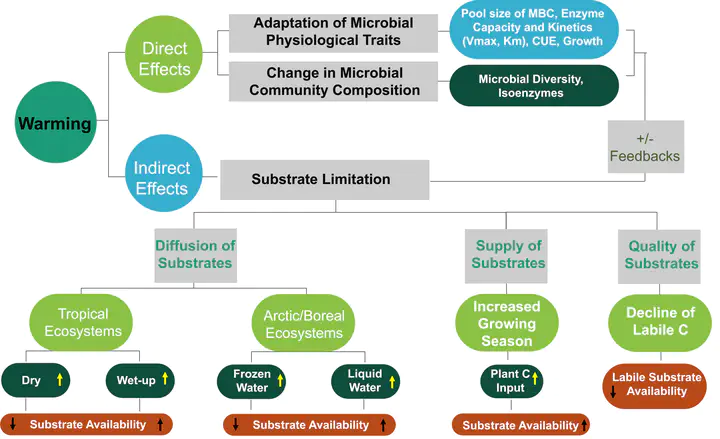
This DOE-funded (Environmental System Science Program) synthesis project investigates how soil carbon (C) loss responds to warming across climate extremes—specifically, cold (Arctic/boreal) and hot (tropical) ecosystems. Soils are the largest terrestrial C pool, and their warming-induced CO₂ emissions could significantly amplify climate change. However, responses to warming vary across ecosystems due to complex interactions among temperature, microbial communities, enzyme kinetics, substrate availability, and moisture.
The interdisciplinary team will synthesize long-term data from six intensively studied field sites (including Puerto Rico, Alaska, Colorado, and Panama) and employ mechanistic biogeochemical models (e.g., DAMM, MEND, AquaMEND) along with explainable machine learning tools (e.g., LIME). The goal is to identify the direct and indirect drivers of temperature-sensitive soil respiration and disentangle how microbial processes differ between climate zones.