Understanding biophysical drivers of the CH4 source sink transition in Northern Forests
Total Funding: $1,655,957 (Emory: $329,238)
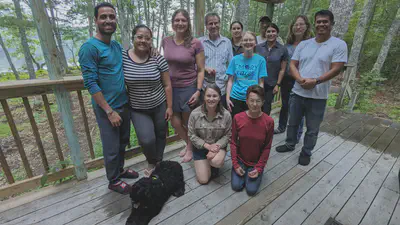
Meet our multi-institute collaborative team members: Woodwell Climate Research Center, lead institute: Jennifer Watts (PI), Kathleen Savage (Co-PI) NC State University: Debjani Sihi (PI) San Diego State University: Xiaofeng Xu (PI) Arizona State University: Hinsby Cadillo-Quiroz (PI) University of Maine: Shawn Fraver (PI) USDA Forest Service: David Hollinger (Collaborator)
Brief description of the project :
We will obtain multi-scale observations of soil and aboveground methane fluxes, microbial traits, and associated in-situ environmental conditions. By using a suite of in-situ and lab-based experimental observations of methane production and oxidation, stable isotopes, microbial community composition and function, we hope to improve our understanding of the mechanisms, processes, and feedbacks driving methane sink/source activity across the microsite to landscape level. These datasets, integrated with project data-enhanced M3D-DAMM and CLM-Microbe process models, will enable us to answer the key questions of what are the primary environmental and biological controls of net methane sink/source activity in a sub-boreal forest, and how do these controls vary across space and time? To further understand and quantify methane response, we employ in-situ and laboratory manipulation experiments to identify the role of functional guild activity, under changing environmental conditions, in regulating methane production/oxidation and ultimately net methane flux to and from the atmosphere. Finally, we will apply our integrated datasets and data-informed/enhanced models to identify seasonal and annual methane sink/source activity at a sub-boreal forest (Howland forest) in New England region of USA from present to 2100.
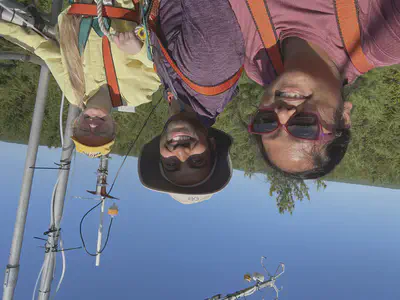
We climbed the EC Tower
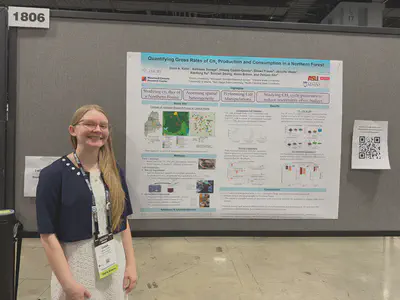
Dana Kahn (former MS student) presenting at the AGU meeting
For more information, please see our project website.